Fitting a week’s worth of clothing into a single carry-on bag is a common challenge for many travelers. Traditional folding techniques often leave awkward gaps in your luggage and cause deep creases in your garments. When space is at an absolute premium, mastering the ranger roll packing method provides the ultimate solution. This highly efficient technique forces trapped air out of fabrics, condensing your wardrobe into small, manageable units that fit perfectly into any travel bag.
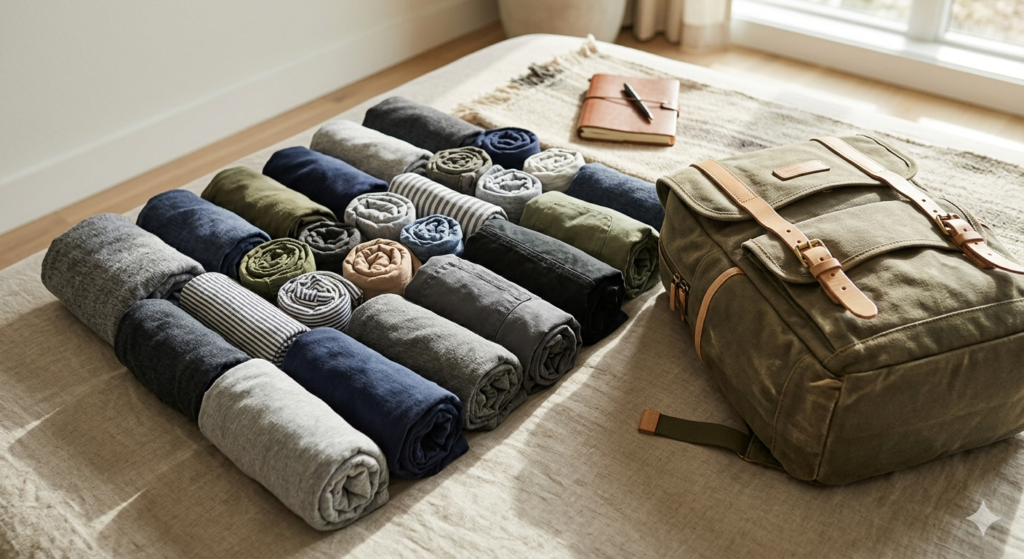
What is the Ranger Roll?
The ranger roll packing method, also known as the military roll, is a highly space-efficient folding technique. It involves tightly rolling a garment into a compact cylinder and wrapping the fabric’s edge over itself to create a secure, self-contained bundle that will not unroll during transit.
This technique originated in the armed forces as a way to maximize limited space inside heavy rucksacks. By creating a tight, uniform shape, the military roll allows you to stack clothing like bricks inside your bag. It ensures that your garments stay exactly how you packed them, even if your luggage is jostled during a flight.
Travelers often debate what is flat packing compared to rolling. Flat packing involves laying garments completely flat on top of one another, which works well for stiff, formal wear but takes up a large surface footprint. The ranger roll, conversely, prioritizes maximizing three-dimensional volume by eliminating empty air pockets between items.
Step-by-Step Tutorial for T-Shirts
Learning this technique requires a bit of practice, but the process becomes second nature very quickly. When first learning, utilizing a flexible, forgiving garment like a lightweight travel t-shirt makes the folding process much smoother. Start by finding a flat, clean surface like a bed or a table.
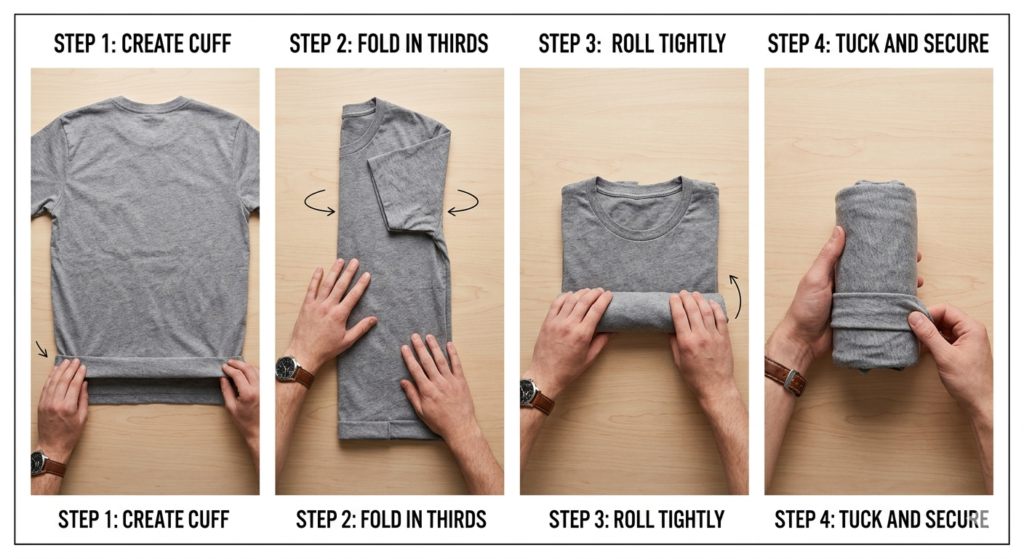
Follow these steps to execute the perfect roll:
- Lay it flat: Smooth the shirt out completely to remove any existing wrinkles.
- Create the cuff: Fold the bottom hem of the shirt inside out, bringing it up about two to three inches to form a pocket across the bottom.
- Fold in thirds: Fold the left side of the shirt across the center, smooth the sleeve flat, and then fold the right side over the left.
- Roll tightly: Starting from the collar, roll the shirt downwards as tightly as possible toward the bottom hem.
- Secure the bundle: Once you reach the bottom, take the cuff you created in step two and wrap it backward over the entire roll to lock it in place.
Applying the Technique to Pants and Socks
This method is not limited to just shirts; it works exceptionally well for pants, shorts, and even underwear. To roll a pair of pants, lay them flat and turn the top waistband inside out by a few inches to create your cuff. Fold the legs in half vertically, roll tightly from the ankles up to the waist, and wrap the inverted waistband over the roll.
The primary reason to roll clothes instead of fold them is the dramatic reduction in packing volume. Rolled cylinders slide effortlessly into packing cubes or the tight corners of a backpack, utilizing dead space that folded squares leave behind. Furthermore, the tight tension of the roll prevents fabrics from shifting and creating hard creases.
Once you have compressed your entire wardrobe into these compact cylinders, arranging them inside your luggage becomes a simple game of geometry. For a comprehensive guide on where to place these rolled items for optimal weight distribution, review our tutorial on How to Pack a Backpack for Travel.
Conclusion
Adopting the ranger roll packing method is a highly effective way to gain control over your luggage space. By utilizing the military roll, you compress your clothing into secure, uniform shapes that maximize internal capacity and minimize fabric creasing. Whether you are packing for a weekend getaway or a multi-month expedition, taking the time to tightly roll your garments ensures a more organized, efficient, and stress-free travel experience.
Frequently Asked Questions (FAQ)
Does the ranger roll stretch out the collars or hems of clothing?
If done too aggressively with delicate fabrics, the tension of the cuff can cause minor stretching over long periods. However, for standard cotton, synthetic blends, and durable travel fabrics, the method is entirely safe and will not cause permanent damage.
Does rolling clothes prevent wrinkles better than folding?
Yes, because rolling eliminates the hard creases caused by folding a garment flat. As long as you smooth the fabric flat before you begin rolling, the tension of the cylinder keeps the material taut and prevents new wrinkles from forming in transit.
Can I use the military roll on heavy winter jackets or sweaters?
The military roll is most effective on base layers, t-shirts, light pants, and mid-layers. Heavy winter jackets and thick wool sweaters are generally too bulky to fold a cuff into, making them difficult to secure properly with this specific technique.