Packing toiletries for a flight is often the most stressful part of preparing for a trip. Arriving at the security checkpoint only to have an agent confiscate your expensive skincare or favorite shampoo is incredibly frustrating. This friction usually stems from a misunderstanding of how aviation authorities classify and restrict everyday items. By taking the time to understand the strict framework governing carry-on luggage, you can completely eliminate this anxiety. This ultimate guide to TSA liquid rules breaks down exactly what you are allowed to bring, how it must be packed, and the exceptions that can save you time at the airport.
Understanding the Foundation: The 3-1-1 Rule
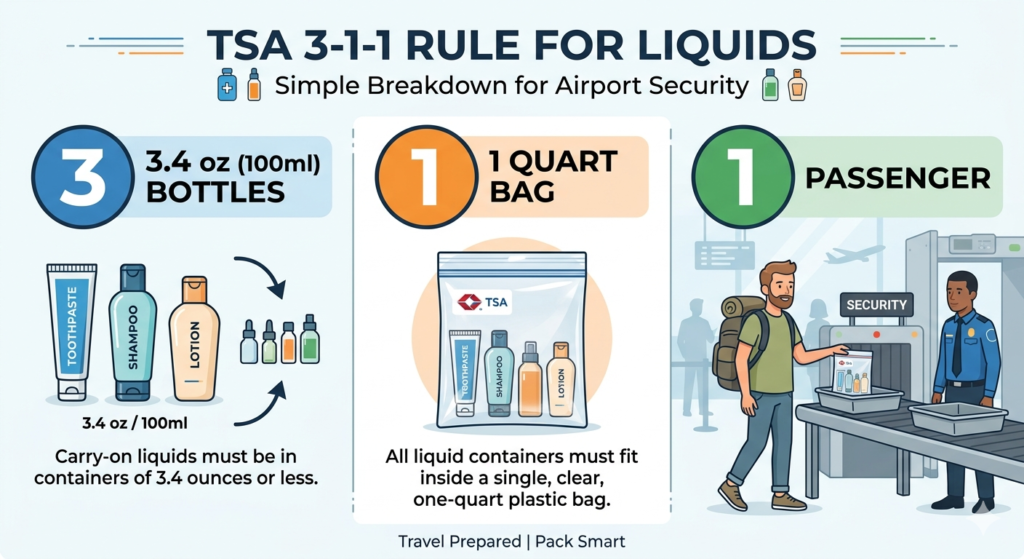
This guide to TSA liquid rules centers on the foundational 3-1-1 rule. It states that all liquids, aerosols, gels, creams, and pastes must be in containers of 3.4 ounces (100 milliliters) or less, and all containers must fit inside one single quart-sized clear plastic bag per passenger.
This rule was implemented globally to standardize security procedures and ensure the safety of commercial flights. The numbers in the 3-1-1 rule serve as a simple memory aid: 3.4 ounces per container, 1 quart-sized bag, and 1 bag per passenger. If an item does not conform to this structure, it must go into checked luggage or be surrendered at the security gate.
It is crucial to note that the rule applies to the capacity of the container, not the volume of liquid inside it. If you bring a 6-ounce bottle that is almost empty and contains only 2 ounces of lotion, security agents will still confiscate it. The container itself must hold no more than 3.4 ounces.
Defining Airport Security Liquids
Many travelers fall victim to confiscation because they misunderstand what actually counts as a liquid. The TSA definition extends far beyond obvious items like water, shampoo, and perfume. If a substance can be squeezed, sprayed, spread, or poured, it falls under the restriction.
Common items classified as airport security liquids include:
- Gels: Hair styling gel, hand sanitizer, and gel deodorant.
- Aerosols: Hairspray, shaving cream, and spray deodorant.
- Creams and Pastes: Toothpaste, peanut butter, lotion, and soft cheeses like brie.
- Cosmetics: Liquid foundation, mascara.
A helpful rule of thumb used by security agents is the “shape” test. If the item does not hold its own shape outside of its container, it is considered a liquid, gel, or aerosol, and must be placed in your clear bag.
Maximizing Your Carry On Liquid Limits
Fitting your entire daily hygiene routine into a single small bag requires strict discipline. While a standard household resealable plastic bag works, it is prone to tearing and blowing out at the seams when stuffed. Investing in a durable, TSA-approved clear toiletry bag is highly recommended for frequent travelers. These specific bags utilize structured seams and heavy-duty zippers to maximize usable volume while remaining fully compliant with regulations.
To optimize your carry on liquid limits, you must master the art of decanting. Never buy travel-sized versions of products you already own; they are expensive and rarely feature the best packaging. Instead, purchase small, reusable silicone bottles and fill them from your large bottles at home.
Furthermore, you can drastically reduce your liquid footprint by swapping to solid alternatives. Solid shampoo bars, solid deodorant, and dehydrated toothpaste tablets do not count against your liquid allowance, freeing up precious space for items that cannot be swapped, like contact lens solution.
TSA Exemptions and Special Cases
While the standard rules are strictly enforced for toiletries and food, the TSA provides specific exemptions for medically necessary liquids and infant care items. These essential items are allowed in reasonable quantities that exceed the standard 3.4-ounce limit.
Exempt items include:
- Prescription liquid medications.
- Over-the-counter liquid medications (like cough syrup).
- Saline solution and eye drops.
- Breast milk, baby formula, and baby food (even if the infant is not present).
To utilize these exemptions, you must declare the oversized items to the TSA officer at the beginning of the screening process. You should pack them in an easily accessible area of your carry-on, separate from your standard quart-sized liquids bag, as they will likely require additional, separate screening or testing.
Conclusion
Navigating airport security does not have to be a tense experience of hoping your bag passes through the scanner without triggering an alarm. By utilizing this guide to TSA liquid rules, you can pack with total confidence. Understanding the strict parameters of the 3-1-1 rule, correctly identifying what counts as a liquid, and utilizing smart decanting strategies ensures you maximize your carry-on space. Prepare your liquids properly before you reach the airport, and you will enjoy a frictionless, stress-free start to your journey.
Frequently Asked Questions (FAQ)
Can I bring an empty water bottle through TSA security?
Yes, you can bring an empty reusable water bottle of any size through the security checkpoint. The restriction only applies to the liquid inside. Once you clear security, you can fill the bottle at an airport water fountain before your flight.
Is stick deodorant considered a liquid or gel?
Solid stick deodorants and antiperspirants are not considered liquids or gels, and they can be packed in any size anywhere in your carry-on luggage. However, gel deodorants, roll-on liquid deodorants, and aerosol spray deodorants must comply with the 3.4-ounce limit.